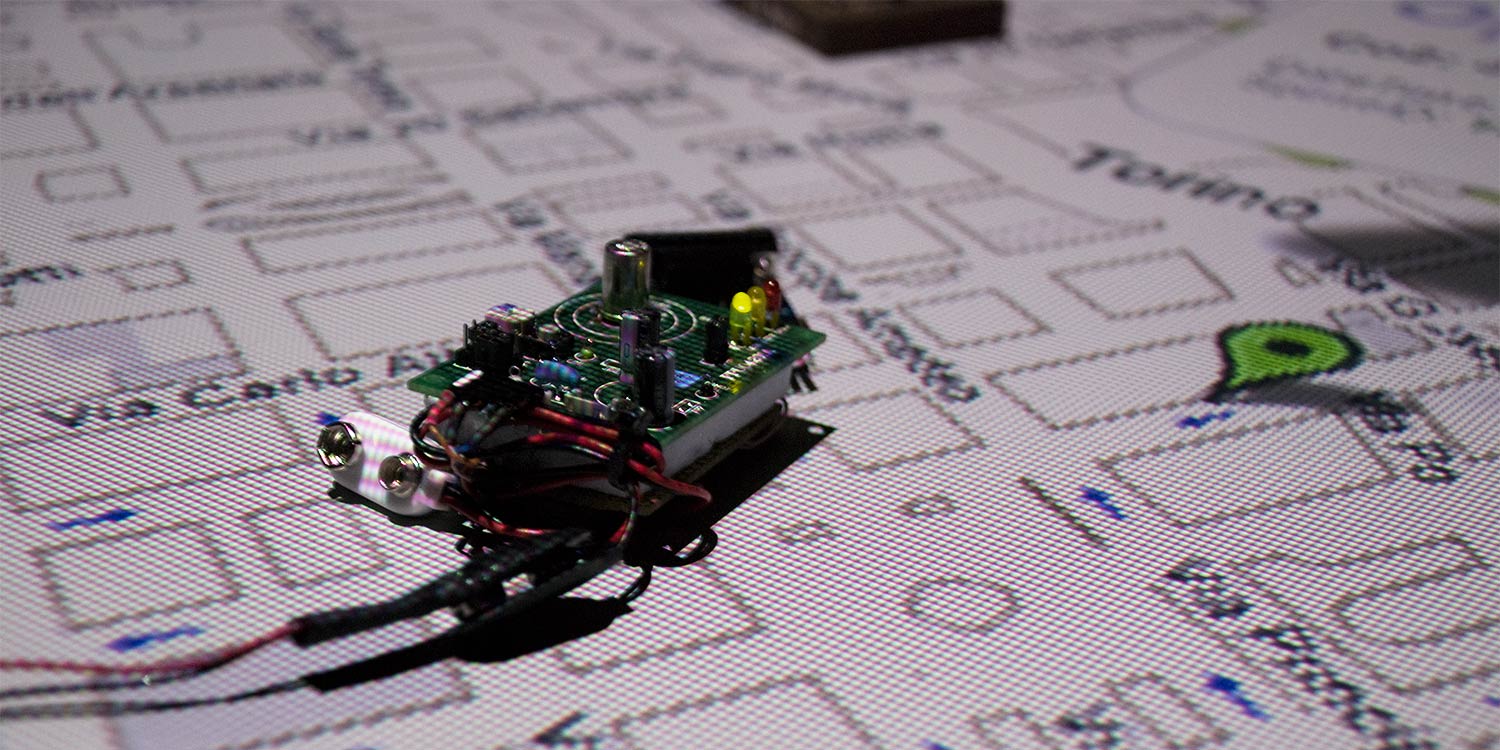
Due to my personal interests and history, I often find myself building applications in field of the Internet Of Things. Most of the times I end up using Erlang: it is based on the Actor's Model and is an ideological (and practical) perfect match to manage IoT interactions.
I recently built an application where devices can connect to, and interact with each other. Every device is identified via a unique ID (its serial number) and based on this ID the devices can send and receive messages. Nothing new here: it's a standard messaging platform, which supports a custom protocol.
Due to the large amount of devices that I needed to support, this application runs on a cluster of Erlang nodes. Once a device connects to one of those nodes, the related TCP socket events are handled by a process running on that node. To send a message to a specific device, you send a message to the process that handles the devices's TCP socket.
While building this application, I was early in the process faced with a very common problem: I needed a global process registry that would allow me to globally register a process based on its serial number, so that messages can be sent from anywhere in the cluster. This registry would need to have the following main characteristics:
- Distributed.
- Fast write speeds (>10,000 / sec).
- Handle naming conflict resolution.
- Allow for adding/removal of nodes.
Therefore I started to search for possible solutions (which included posting to the Erlang Questions mailing list), and these came out as my options:
The Stress Test
I decided to evaluate every one of these solutions based on a variety of considerations. However, I also wanted to see how they would perform when submitted to some kind of a stress test. Therefore, I defined and wrote a simple one that:
- Launches a certain number of processes per node (for example, 25,000 processes per node).
- Registers these processes (25,000 processes per node), each with a globally unique Key.
- Waits for those Keys to be propagated to all the nodes.
- Unregisters all of these processes.
- Waits for those Keys to be removed from all the nodes.
- Re-registers all of the processes, to check for unwanted effects of subsequent add/remove operations.
- Again, waits for those Keys to be propagated to all the nodes.
- Kills all the processes (this time, without previously unregistering them).
- Waits for those Keys to be removed from all the nodes (to check for process monitoring).
The test measures how long each one of these steps takes.
The following is the code for this stress test. You can see that it defines a behaviour: this is to implement callback modules that match the different syntax used by the different libraries.
ERLANG
-module(process_registry_bench).

-export([start/3]).
-export([register/2, unregister/2]).
-export([register_on_node/2, unregister_on_node/2]).

-callback init() -> term().
-callback register(Key :: string(), pid()) -> term().
-callback unregister(Key :: string(), pid()) -> term().
-callback retrieve(Key :: string()) -> pid() | undefined.
-callback process_loop() -> any().

-define(MAX_RETRIEVE_WAITING_TIME, 60000).


start(CallbackModule, ProcessesCount, Nodes) ->
	%% connect
	connect_nodes(Nodes),

	%% callback init
	CallbackModule:init(),

	%% launch processes
	{UpperKey, PidInfos} = launch_processes(CallbackModule, ProcessesCount),

	%% benchmark: register
	{TimeReg, _} = timer:tc(?MODULE, register, [CallbackModule, PidInfos]),
	io:format("Registered processes in ~p sec, at a rate of ~p/sec~n", [
		TimeReg/1000000,
		ProcessesCount/TimeReg*1000000
	]),

	%% benchmark: registration propagation
	{RetrievedInMs1, RetrieveProcess1} = retrieve(pid, CallbackModule, UpperKey),
	io:format("Check that process with Key ~p was found: ~p in ~p ms~n", [
		UpperKey, RetrieveProcess1, RetrievedInMs1
	]),

	%% benchmark: unregister
	{TimeUnreg, _} = timer:tc(?MODULE, unregister, [CallbackModule, PidInfos]),
	io:format("Unregistered processes in ~p sec, at a rate of ~p/sec~n", [
		TimeUnreg/1000000,
		ProcessesCount/TimeUnreg*1000000
	]),

	%% benchmark: unregistration propagation
	{RetrievedInMs2, RetrieveProcess2} = retrieve(undefined, CallbackModule, UpperKey),
	io:format("Check that process with Key ~p was NOT found: ~p in ~p ms~n", [
		UpperKey, RetrieveProcess2, RetrievedInMs2
	]),

	%% benchmark: re-registering
	{TimeReg2, _} = timer:tc(?MODULE, register, [CallbackModule, PidInfos]),
	io:format("Re-registered processes in ~p sec, at a rate of ~p/sec~n", [
		TimeReg2/1000000,
		ProcessesCount/TimeReg2*1000000
	]),

	%% benchmark: re-registration propagation
	{RetrievedInMs3, RetrieveProcess3} = retrieve(pid, CallbackModule, UpperKey),
	io:format("Check that process with Key ~p was found: ~p in ~p ms~n", [
		UpperKey, RetrieveProcess3, RetrievedInMs3
	]),

	%% benchmark: monitoring
	io:format("Kill all processes~n", []),
	kill_processes(PidInfos),
	{RetrievedInMs4, RetrieveProcess4} = retrieve(undefined, CallbackModule, UpperKey),
	io:format("Check that process with Key ~p was NOT found: ~p in ~p ms~n", [
		UpperKey, RetrieveProcess4, RetrievedInMs4
	]).

connect_nodes(Nodes) ->
    [true = net_kernel:connect_node(Node) || Node <- Nodes].

launch_processes(CallbackModule, ProcessesCount) ->
	%% return the processes info in format [{Node, [{Key, Pid}]}, ...]
	Nodes = [node() | nodes()],
	ProcessesPerNode = round(ProcessesCount / length(Nodes)),
	UpperKey = integer_to_list(ProcessesPerNode * length(Nodes)),
	F = fun(Node, Acc) ->
		StartingKey = length(Acc) * ProcessesPerNode,
		Pids = launch_processes_on_node(CallbackModule, ProcessesPerNode, StartingKey, Node),
		[{Node, Pids} | Acc]
	end,
	{UpperKey, lists:foldl(F, [], Nodes)}.
launch_processes_on_node(CallbackModule, ProcessesPerNode, StartingKey, Node) ->
	%% return the key and process in a list of format [{Key, Pid}, ...]
	Seq = [
		integer_to_list(Key)
		|| Key <- lists:seq(StartingKey + 1, ProcessesPerNode + StartingKey)
	],
	[{Key, spawn(Node, CallbackModule, process_loop, [])} || Key <- Seq].

register(CallbackModule, PidInfos) ->
	%% register in parallel on all nodes
	F = fun({Node, NodePidInfos}, Acc) ->
		RpcKey = rpc:async_call(Node, ?MODULE, register_on_node, [
			CallbackModule, NodePidInfos
		]),
		[{Node, RpcKey} | Acc]
	end,
	RpcKeys = lists:foldl(F, [], PidInfos),
	%% wait for registration to complete on all nodes
	FResult = fun({Node, RpcKey}) ->
		Registered = rpc:yield(RpcKey),
		io:format("Registered ~p processes on node ~p~n", [Registered, Node])
	end,
	lists:foreach(FResult, RpcKeys).
register_on_node(CallbackModule, NodePidInfos) ->
	F = fun({Key, Pid}) ->
		CallbackModule:register(Key, Pid)
	end,
	lists:foreach(F, NodePidInfos),
	length(NodePidInfos).

retrieve(Expected, CallbackModule, Key) ->
	StartTime = epoch_time_ms(),
	retrieve(Expected, CallbackModule, Key, StartTime).
retrieve(pid, CallbackModule, Key, StartTime) ->
	%% wait for a pid to be returned
	case CallbackModule:retrieve(Key) of
		undefined ->
			timer:sleep(50),
			case epoch_time_ms() > StartTime + ?MAX_RETRIEVE_WAITING_TIME of
				true -> {error, timeout_during_retrieve};
				false -> retrieve(pid, CallbackModule, Key, StartTime)
			end;
		{error, Error} ->
			{error, Error};
		Pid ->
			RetrievedInMs = epoch_time_ms() - StartTime,
			{RetrievedInMs, Pid}
	end;
retrieve(undefined, CallbackModule, Key, StartTime) ->
	%% wait for undefined to be returned
	case CallbackModule:retrieve(Key) of
		undefined ->
			RetrievedInMs = epoch_time_ms() - StartTime,
			{RetrievedInMs, undefined};
		{error, Error} ->
			{error, Error};
		_Pid ->
			timer:sleep(50),
			case epoch_time_ms() > StartTime + ?MAX_RETRIEVE_WAITING_TIME of
				true -> {error, timeout_during_retrieve};
				false -> retrieve(undefined, CallbackModule, Key, StartTime)
			end
	end.

unregister(CallbackModule, PidInfos) ->
	%% unregister in parallel on all nodes
	F = fun({Node, NodePidInfos}, Acc) ->
		RpcKey = rpc:async_call(Node, ?MODULE, unregister_on_node, [
		CallbackModule, NodePidInfos
		]),
		[{Node, RpcKey} | Acc]
	end,
	RpcKeys = lists:foldl(F, [], PidInfos),
	%% wait for unregistration to complete on all nodes
	FResult = fun({Node, RpcKey}) ->
		Unregistered = rpc:yield(RpcKey),
		io:format("Unregistered ~p processes on node ~p~n", [Unregistered, Node])
	end,
	lists:foreach(FResult, RpcKeys).
unregister_on_node(CallbackModule, NodePidInfos) ->
	F = fun({Key, Pid}) ->
		CallbackModule:unregister(Key, Pid)
	end,
	lists:foreach(F, NodePidInfos),
	length(NodePidInfos).

kill_processes(PidInfos) ->
	F = fun({_Node, NodePidInfos}) ->
		[exit(Pid, kill) || {_Key, Pid} <- NodePidInfos]
	end,
	lists:foreach(F, PidInfos).

epoch_time_ms() ->
    {Mega, Sec, Micro} = os:timestamp(),
    (Mega * 1000000 + Sec) * 1000 + round(Micro / 1000).
To run this stress test:
ERLANG
process_registry_bench:start(CallbackModule, ProcessCount, Nodes).
For instance, to launch it with the callback module global_bench for 100,000 processes running on a cluster of 4 nodes ['1@127.0.0.1', '2@127.0.0.1', '3@127.0.0.1', '4@127.0.0.1']:
ERLANG
process_registry_bench:start(global_bench, 100000, [
    '1@127.0.0.1',
    '2@127.0.0.1',
    '3@127.0.0.1',
    '4@127.0.0.1'
]).
Running this test returns an output similar to:
Registered 25000 processes on node '1@127.0.0.1'
Registered 25000 processes on node '2@127.0.0.1'
Registered 25000 processes on node '3@127.0.0.1'
Registered 25000 processes on node '4@127.0.0.1'
Registered processes in 6.385835 sec, at a rate of 15659.659230155492/sec
Check that process with Key "100000" was found: <6218.25065.0> in 0 ms
Unregistered 25000 processes on node '1@127.0.0.1'
Unregistered 25000 processes on node '2@127.0.0.1'
Unregistered 25000 processes on node '3@127.0.0.1'
Unregistered 25000 processes on node '4@127.0.0.1'
Unregistered processes in 4.481706 sec, at a rate of 22312.93172733776/sec
Check that process with Key "100000" was NOT found: undefined in 0 ms
Registered 25000 processes on node '1@127.0.0.1'
Registered 25000 processes on node '2@127.0.0.1'
Registered 25000 processes on node '3@127.0.0.1'
Registered 25000 processes on node '4@127.0.0.1'
Re-registered processes in 4.943493 sec, at a rate of 20228.611631492146/sec
Check that process with Key "100000" was found: <6218.25065.0> in 0 ms
Kill all processes
Check that process with Key "100000" was NOT found: undefined in 0 ms
ok
The Process Registry Libraries
The following are the considerations that I made for every solution.
1. Erlang's native global module
Considerations
The Erlang global module has native functionalities to support a global process registry. I was not particularly attracted to it, because:
- I always think that this module should be used to identify application's long-running services.
- I didn't know if millions of entries can be supported. This module wasn't built with my use case in mind: as per my previous point, it is generally used to register long-running processes.
- It has a locking mechanism to ensure that the registration is atomic. I felt this could become a serious bottleneck to the registration of processes.
However, this is a native Erlang module, which also allows to define a resolve function to be used for conflict resolution (i.e. in case of race conditions, or during net splits, when a Key gets registered simultaneously on two different nodes). It is able to satisfy the distributed requirements out of the box, with no need for additional libraries.
Stress Test
I gave it a go at my stress test, with the following callback module:
ERLANG
-module(global_bench).
-behaviour(process_registry_bench).

-export([init/0]).
-export([register/2, unregister/2]).
-export([retrieve/1]).
-export([process_loop/0]).

init() ->
	ok.

register(Key, Pid) ->
	yes = global:register_name(Key, Pid).

unregister(Key, _Pid) ->
	global:unregister_name(Key).

retrieve(Key) ->
	global:whereis_name(Key).

process_loop() ->
	receive
		_ -> ok
	end.
Note that process_loop (which is the loop running in the processes) does nothing, except keeping the process alive.
The results of the stress test are:
[table colalign="left|right|right|right|right"]
,1 Node,2 Nodes,3 Nodes,4 Nodes
Reg / second,"27,233","2,673","1,997","1,579"
Retrieve registered Key (ms),0,0,0,0
Unreg / second,"29,491","2,908","2,206","1,596"
Retrieve unregistered Key (ms),0,0,0,0
Re-Reg / second,"27,149","2,993","2,131","2,542"
Retrieve re-registered Key (ms),0,0,0,0
Retrieve Key of killed Pid (ms),0,timeout,timeout,timeout
[/table]
Conclusions
- The locking mechanism heavily influences the decrease in performance that can be seen when adding nodes. With a cluster of 2+ nodes we already are under the spec of 10,000 registrations / second.
- The monitoring of processes is slow. After having killed all the processes, in a cluster of 2+ nodes it takes more than 60 seconds to have
global:whereis_name/1 return undefined (this is what timeout means in the table here above). I had to decrease the number of processes to around 80,000 to have the stress test pass in a cluster of 4 nodes, and it would take around 55 seconds for a killed process' Key to be removed from the registry.
For these reasons, it didn't look like I could use this module.
2. Erlang's native pg2 module
Considerations
Erlang pg2 module has native functionalities to support a global process registry. I was not particularly attracted to it, because:
- This library handles Process Groups, which is very different from handling unique Registered Names. We can use it for our purpose though, by basically creating Groups with a single entry. These groups are named according to our Keys, and every Group has a single entry: the Pid that we are registering. This is kind of a trick, but it's not a showstopper.
- Having Process Groups basically means that conflict resolution isn't covered. If two processes are registered on different nodes with the same Key (because of race conditions or during a net split) this will result in having a Process Group with two elements instead of one. Sometimes this is fine; however, I wanted to ensure that there would be a clearly identified single Pid per device in the whole system. Not a showstopper either, but a turn-off.
- I didn't know if millions of entries can be supported. This module wasn't built with my use case in mind.
- Here too, it has a locking mechanism to ensure that the registration is atomic which could become a bottleneck to the registration of processes.
Stress Test
Here's the callback module:
ERLANG
-module(pg2_bench).
-behaviour(process_registry_bench).

-export([init/0]).
-export([register/2, unregister/2]).
-export([retrieve/1]).
-export([process_loop/0]).

init() ->
	ok.

register(Key, Pid) ->
	ok = pg2:create(Key), %% create group
	ok = pg2:join(Key, Pid). %% add pid

unregister(Key, _Pid) ->
	ok = pg2:delete(Key).

retrieve(Key) ->
	case pg2:get_members(Key) of
		{error, {no_such_group, Key}} -> undefined;
		[] -> undefined;
		[Pid] -> Pid
	end.

process_loop() ->
	receive
		_ -> ok
	end.
The results of the stress test are:
[table colalign="left|right|right|right|right"]
,1 Node,2 Nodes,3 Nodes,4 Nodes
Reg / second,"25,062","3,823","2,914","1,862"
Retrieve registered Key (ms),0,0,0,0
Unreg / second,"39,522","6,903","5,191","3,425"
Retrieve unregistered Key (ms),0,0,0,0,
Re-Reg / second,"25,701","3,794","2,783","1,817"
Retrieve re-registered Key (ms),0,0,0,0
Retrieve Key of killed Pid (ms),timeout,timeout,timeout,timeout
[/table]
Conclusions
- The locking mechanism heavily influences the decrease in performance that can be seen when adding nodes. With a cluster of 2+ nodes we already are under the spec of 10,000 registrations / second.
- The monitoring of processes is slow. After having killed all the processes, even on a single nodes it takes more than 60 seconds to have
pg2:get_members/1 return that the group no longer exits. I had to decrease the number of processes to around 45,000 to have the stress test pass in a cluster of 4 nodes, and it would take a little less than 60 seconds for a killed process' Key to be removed from the registry.
For these reasons, it didn't look like I could use this module.
3. Gproc
Considerations
gproc is a well-known process registry which is normally used for the additional features that it provides on top of Erlang's native process dictionary (for instance, it is able to provide pub/sub patterns). It is a solid and well-supported library, and you can often see Ulf Wiger (one of the library's authors) generously providing support for it.
However, there were some concerns I had:
- For the distributed part it relies on
gen_leader, on which I've heard too many horror stories (maybe that's not a thing anymore). Ulf pointed me to a gproc branch that uses locks_leader, where he is mainly concentrating his efforts for gproc's support for distributed operations.
- I felt that the main purpose of this library is not to provide a distributed process registry as much as extending the existing Erlang registration mechanisms with some additional features. The README in gproc's Github page clearly depicts it as being an "Extended process dictionary"; it just felt that the distributed part hasn't been the primary focus in the development of this library.
- I could not understand how conflict resolution is managed in a distributed environment.
Stress Test
Here's the callback module:
ERLANG
-module(gproc_bench).
-behaviour(process_registry_bench).

-export([init/0]).
-export([register/2, unregister/2]).
-export([retrieve/1]).
-export([process_loop/0]).

init() ->
	%% start app on every node
	Nodes = [node() | nodes()],
	F = fun(Node) ->
		rpc:call(Node, application, ensure_all_started, [gproc]),
		rpc:call(Node, gproc_dist, start_link, [Nodes])
	end,
	lists:foreach(F, Nodes).

register(Key, Pid) ->
	Pid ! {self(), reg, Key},
	receive
		done -> ok
	end.

unregister(Key, Pid) ->
	Pid ! {self(), unreg, Key},
	receive
		done -> ok
	end.

retrieve(Key) ->
	case catch gproc:lookup_pid({n, g, Key}) of
		{'EXIT', _} -> undefined;
		Pid -> Pid
	end.

process_loop() ->
	receive
		{Sender, reg, Key} ->
			gproc:reg({n, g, Key}, ignored),
			Sender ! done,
			process_loop();
		{Sender, unreg, Key} ->
			gproc:unreg({n, g, Key}),
			Sender ! done,
			process_loop()
	end.
Note: in gproc, to ensure thread safety, a process can only set its own values. That's why the register/2 and unregister/2 callbacks here above send messages to the processes, which then register or unregister themselves (see process_loop). As you can see here above I've decided to provide a locking call for these functions (by using a receive block), to emulate the locking calls that I've used in the other libraries.
The results of the stress test are:
[table colalign="left|right|right|right|right"]
,1 Node,2 Nodes,3 Nodes,4 Nodes
Reg / second,"67,011","19,111","22,048","15,659"
Retrieve registered Key (ms),0,0,0,0
Unreg / second,"118,228","22,845","24,282","22,312"
Retrieve unregistered Key (ms),0,0,0,0
Re-Reg / second,"127,200","22,115","25,884","20,228"
Retrieve re-registered Key (ms),0,0,0,0
Retrieve Key of killed Pid (ms),178,"1,890","7,584","10,600"
[/table]
Conclusions
- These are overall very good results.
- I didn’t need to reduce the process count to make all of the test pass.
- The monitoring of processes can be optimized. After having killed all the processes, on a cluster of 4 nodes it takes >10 seconds for
gproc:lookup_pid/1 to not find the Pid once a process has exited.
- Unfortunately, I had some inconsistent results running this test in a cluster of 2+ nodes. Often, the test could not retrieve the registered Key (after the first registration round) in less than 60 second, and timed out.
I was a little skeptical though on the inconsistency that I saw in the test results, which might be related to the gen_leader issues that I've occasionally heard about. The author's choice to move towards locks_leader might be a sign of this. Despite these thoughts, this looked like a good potential candidate.
4. CloudI Process Groups
Considerations
cpg is an actively maintained library, and his main author Michael Truog is often very available to discuss his choices and provide support. cpg deals with Process Groups and not unique Registered Names, therefore my concerns where similar to the ones I had with pg2:
- Handling Process Groups is very different from handling unique Registered Names. We can use the same trick used with pg2, i.e. creating Process Groups named with Key, with a single entry (the Pid).
- Here too, having Process Groups basically means that conflict resolution isn't covered. This made me a little uncomfortable because I wanted to ensure that there would be a clearly identified single Pid per device in the whole system.
Stress Test
Here's the callback module:
ERLANG
-module(cpg_bench).
-behaviour(process_registry_bench).

-export([init/0]).
-export([register/2, unregister/2]).
-export([retrieve/1]).
-export([process_loop/0]).

init() ->
	%% start app on every node
	Nodes = [node() | nodes()],
	[rpc:call(Node, reltool_util, application_start, [cpg]) ||  Node <- Nodes].

register(Key, Pid) ->
	ok = cpg:join(Key, Pid).

unregister(_Key, Pid) ->
	ok = cpg:leave(Pid).

retrieve(Key) ->
	case catch cpg:get_members(Key) of
		{ok, Key, [Pid]} -> Pid;
		{error, {no_such_group, Key}} -> undefined;
		Error -> {error, Error}
	end.

process_loop() ->
	receive
		_ -> ok
	end.
The results of the stress test are:
[table colalign="left|right|right|right|right"]
,1 Node,2 Nodes,3 Nodes,4 Nodes
Reg / second,"110,198","42,680","20,703","8,488"
Retrieve registered Key (ms),0,0,0,0
Unreg / second,"109,374","32,264","25,599","15,128"
Retrieve unregistered Key (ms),0,1,0,0
Re-Reg / second,"126,791","30,862","32,138","20,791"
Retrieve re-registered Key (ms),0,0,0,0
Retrieve Key of killed Pid (ms),error,error,error,error
[/table]
Conclusions
- These are overall very good results.
- I was surprised of the major drop in a cluster of 4 nodes. I run this test multiple times and it always returned similar results.
- The monitoring of processes didn't work appropriately. Even on a single node, the test experienced an internal timeout:
{'EXIT',
 {timeout,
  {gen_server,
   call,
   [cpg_default_scope,
    {get_members,
     "100000"}]}}}
I had to decrease the number of processes to around 25,000 to have the stress test pass in a cluster of 4 nodes. The monitoring issue didn't make me feel particularly at ease, however this library did look like a potential candidate.
5. Custom Solution: Syn
Considerations
Since it became clear that I could not use Erlang's native global or pg2 modules, and that the two other libraries I looked into were candidates but each one with their own little twerks, I decided to try a custom solution, which I called syn (short for synonym).
In any distributed system you are faced with a consistency challenge, which is often resolved by having one master arbiter performing all write operations (chosen with a mechanism of leader election), or through atomic transactions. As said here above, I needed a global process registry for an application of the IoT field. In this context, Keys used to identify a process are often the physical object's unique identifier (for instance, its serial or mac address), and are therefore already defined and unique before hitting the system. The consistency challenge is less of a problem in this case, since the likelihood of concurrent incoming requests that would register processes with the same Key is extremely low and, in most cases, acceptable.
Therefore, Availability has been chosen over Consistency and Syn is eventually consistent.
Under the hood, Syn performs dirty reads and writes into a distributed in-memory Mnesia table, replicated across all the nodes of the cluster. This made me feel comfortable that I wouldn't need to reinvent the replication mechanisms of Erlang's native DB, however I needed a way to handle conflict resolution and net splits. For this reason, Syn can automatically manage conflict resolution by implementing a specialized and simplified version of the mechanisms used in Ulf Wiger's unsplit framework.
You can read more about Syn in its github repo.
Stress Test
Here's the callback module:
ERLANG
-module(syn_bench).
-behaviour(process_registry_bench).

-export([init/0]).
-export([register/2, unregister/2]).
-export([retrieve/1]).
-export([process_loop/0]).

init() ->
	%% start app on every node
	Nodes = [node() | nodes()],
	F = fun(Node) ->
		rpc:call(Node, syn, start, []),
		rpc:call(Node, syn, init, [])
	end,
	lists:foreach(F, Nodes).

register(Key, Pid) ->
	ok = syn:register(Key, Pid).

unregister(Key, _Pid) ->
	ok = syn:unregister(Key).

retrieve(Key) ->
	syn:find_by_key(Key).

process_loop() ->
	receive
		_ -> ok
	end.
The results of the stress test are:
[table colalign="left|right|right|right|right"]
,1 Node,2 Nodes,3 Nodes,4 Nodes
Reg / second,"106,324","52,792","60,958","40,929"
Retrieve registered Key (ms),0,0,0,56
Unreg / second,"105,506","50,591","67,042","42,896"
Retrieve unregistered Key (ms),0,0,0,0
Re-Reg / second,"106,424","51,322","77,258","47,125"
Retrieve re-registered Key (ms),0,0,0,0
Retrieve Key of killed Pid (ms),719,995,"1,577","1,825"
[/table]
Conclusions
- These are overall very good results. I'm not sure why Syn is performing better with 3 nodes than with 2 (and I've repeated this test more than once).
- I didn't need to reduce the process count to make all of the test pass.
- The monitoring of processes worked appropriately.
Final notes
I want to stress out how comparisons and these tests are difficult to perform. Every library behaves differently, and it is hard (if not impossible) to define some kind of a common stress test to allow for a better understanding of their performance levels. I gave it a go, but looking at the above definition of my stress test for instance I ask myself: "Why did I set the process count to 100,000? I can see that most libraries behave fine with lower numbers". Also, "What would happen if instead of registering processes sequentially in a single process per node, we had them register themselves simultaneously, therefore increasing the load on the registry?". More importantly, "Does this test represent some kind of real life scenario?".
This article wants to share my thoughts and how I ended up writing Syn. Sure, Syn performs well in the defined use case and stress test, but this does in no way mean that the other libraries here won't perform way better in other stress tests and scenarios. I'd actually be glad to know that someone else is willing to take the time to evaluate these, and other, global process registries. They are a kind of holy grail; and let's remember that anything distributed is never easy, nor given.
As a final note, I'd enjoy reading comments from the library authors or other Erlang enthusiasts. This is such a delicate matter that I'd love to have a healthy exchange of opinions, hopefully contributing to improving all of our experiences.